

The Ugly Busy Season
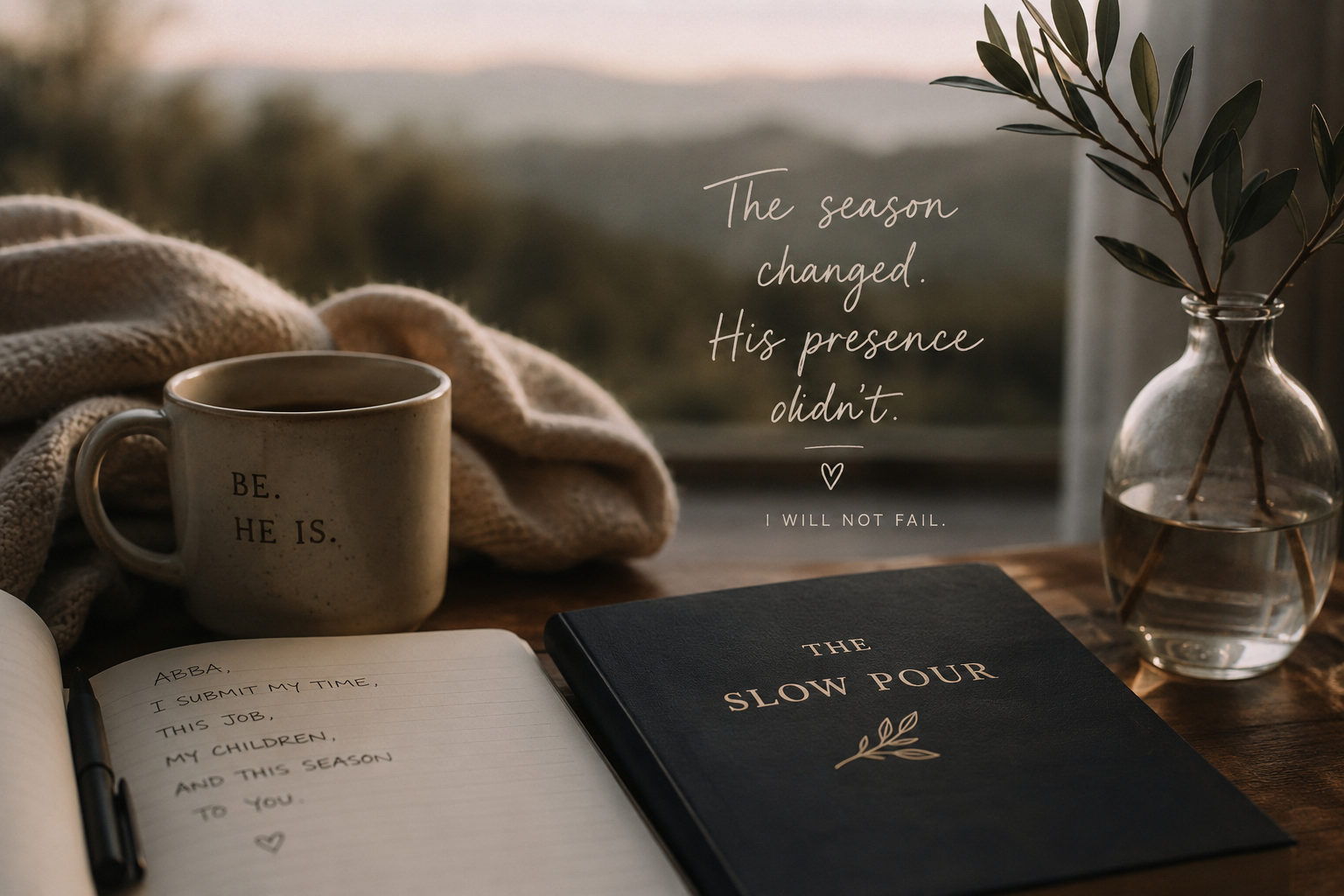
I thought this busy season would pull me away from God. Instead, it’s teaching me to find Him differently—in the shift, the uncertainty, the surrender, and even the chaos. I’m not writing from the other side of this season. I’m writing from inside of it, learning that the season may change, but His presence doesn’t.
It just got real, real fast.
I’ve found that one of the interesting things about studying the Word of God is that whatever you’re studying, whatever He’s giving you revelation about, will more than likely become the very thing you have to experience.
Maybe it makes the witness stronger. Lol! God is funny.
Does that happen to any of you?
In my previous pours, I wrote about detaching from performative practices in order to receive God’s love. I was learning that He just wants my heart. That I don’t have to perform for what He freely gives. I simply have to BE.
And while I’m being, I am kept, because He is the I AM.
Then life changed.
I recently experienced a major life change: I received a promotion. And I know, without a doubt, that it came from God.
When I received the news, I was stoked, scared, grateful, nervous, overwhelmed—just a ball of all kinds of emotions.
But somewhere in the middle of all that gratitude, I became burdened by a thought:
What if I don’t have enough time to spend with God anymore?
I had become so accustomed to these slow study sessions with the King. Sitting with Him. Reading. Studying. Writing. Lingering.
I wanted that to continue.
I still do.
But the season I entered felt like a whirlwind. Everything happened fast and all at once. The kids needed me. The job seemed to require every waking hour. The Slow Pour was pulling at my heart.
Sigh.
And when life stopped feeling slow, I reached for something familiar.
Guilt.
I spent days feeling heavy. Thinking about talking to God instead of actually talking to Him. Worrying about when I would find the time. Trying to figure out how I was going to get everything done.
And slowly, I started to spiral.
I began doubting whether I was capable of doing the job well. In my quiet moments, instead of conversations with Abba, there were tears. Worry. Overthinking.
On the outside, I appeared okay but inwardly, I was wrecked. One day, I started sobbing and telling God, “I don’t want to live a life void of You.” And somewhere in the middle of me sobbing over something that had not even happened, it became abundantly clear: I had forgotten to BE.
Apparently, BE-ing still isn’t my default yet.
Worry is familiar.
Guilt is familiar.
Doubt is familiar.
Overthinking is familiar.
Performing to prove my worth is familiar.
And, well, there was still some residue left.
This ugly busy season exposed it.
So I stopped sobbing and said:
“Abba, I submit my time, this job, my children, and this season to You.”
That simple.
No elaborate prayer.
No perfectly planned quiet time.
No performance.
Just surrender.
Can I be honest with you?
I’m still in the thick of it.
Nothing magically slowed down after that prayer. The responsibilities are still here. The demands are still demanding. I’m still learning how to navigate all of this.
But I have become more intentional about recognizing what triggers me.
One of those triggers is fear.
I started something new, which means change.
Change means a disruption to the status quo.
A disruption to the status quo means I have to shift.
And with a shift often comes this gray area filled with uncertainty and the unknown.
And I don’t like not knowing.
I like clarity. I like understanding what comes next. I like black and white.
But I’m learning that trusting Him in the gray is far better than me knowing what’s in the black and white.
So I’m sitting with the shift.
Not rushing through it.
Not trying to master it overnight.
Not demanding that God show me everything that comes next.
Just sitting with it.
And in doing so, I discovered something I didn’t expect:
I am more aware of His presence because of how uncomfortable the shift is.
The uncertainty draws me nearer and I confide in Him about everything because there is so much I don’t know.
Abba, what do I do with this?
How do I handle that?
Did I do enough today?
Help me with my children.
Help me steward this assignment.
Help me steward my time.
Help me stay close.
Maybe this season isn’t pulling me away from Him after all.
Maybe, in a strange way, it is teaching me another way to be with Him.
Maybe intimacy with God won’t always look like hours at the table with my Bible, journal, and coffee.
Maybe sometimes it looks like whispering “Abba, help me” between responsibilities.
Maybe it looks like surrendering the schedule before the day begins.
and just maybe it looks like finding Him right in the middle of the ugly busy.
Because He isn’t only God in the slow.
He is God in the shift.
He is God in the unknown.
He is God in the gray.
And He is God in the busy.
The season changed.
His presence didn’t.
So I’m still learning to BE.
Not because everything around me is still, but because He is with me in all of it.
And because He is with me, I will not be moved. -Psalm 46:5
Stay close 🤍☕️, especially in this season!

Part 3: The Heart!
It was — and still is — the HEART.
The King. The Law. The Heart!
Before we move into the Heart, we must hold onto what we established in The King Part 1 and what we uncovered in The Law Part 2.
Without understanding the heart of the Father, we will mistake conviction for rejection, obedience for performance, and holiness for perfectionism.
If you haven’t sat with those pours yet, I encourage you to click the titles above and read those first.
In Part 3, we will discover that the deeper issue was never just behavior.
It was always the heart.
Part 3: The Heart!
Paul asked in Galatians 3:19, “What purpose then does the law serve?” What a weighty question.
I’ve often found myself perplexed by the purpose of the law and the tension between Old Testament law and New Testament grace. Prayerfully, I think we can walk through this slowly together, so that we can get to the heart of the matter.
Here’s what we know; before Exodus 20, before the Law was ever given:
Abraham already had relationship with God.
Promise already existed.
Faith was already active and on full display.
Humanity was already being received by God before rules were introduced.
That alone reinforces the reoccurring theme in The Law. Part 2, that “the law was never meant to replace relationship”. It was meant to expose sin, establish order, reveal God’s holiness, and ultimately expose humanity’s need for Him.
Think about human law for a moment.
Laws are meant to govern people and their behavior.
For example, laws have been created against theft and violence, because both infractions exist. The laws did not create this problem; it revealed the problem to us. Laws, whether it’s spiritual laws or human laws, expose predicated behavior that needs to be eliminated or governed.
How often do you unknowingly break laws? National laws. State laws. City ordinances. Most of us don’t know all the laws created to govern our behavior. So how could we perfectly keep them?
Bible scholars estimate that there are 613 total laws throughout Exodus, Leviticus, Numbers and Deuteronomy. Of those, 248 are positive commands, like “thou shall”; while 365 are “thou shall not”.
Many of us can barely remember what we ate last week, so what are the chances of us remembering and abiding by 613 rules?
I was teaching my children the Ten commandments and encouraging them to commit it to memory. While teaching them, I found myself constantly referring to Scripture, not only to remember them accurately, but because I kept experiencing conviction and “ah-ha” moments.
Naturally, my children had tons of questions and although I was conflicted, I encouraged them to ask anyway. Through answering their questions I noticed a pattern. I found myself repenting constantly. I was hyper-aware of every failure, every flaw, and every shortcoming.
Meanwhile, my children started saying things like, “Ooooh, you broke the commandment. God doesn’t like that.”
And while God does care about holiness, I know with certainty He never intended for it to become ammunition for self-righteousness or condemnation. Jesus addressed that constantly with the Pharisees, Sadducees, and scribes.
Before I go any further, I need to confess something honestly: I struggled deeply with perfectionism by way of self-righteousness and condemnation.
At the root of it was a misunderstanding. I wanted to obey God sincerely, but I did not yet understand that relationship was key.
As a child, I believed perfection came through performance.
If I made good grades, I was good.
If I obeyed externally, I was good.
If I attended church faithfully, served consistently, read my Bible daily, accepted everyone, never judged anyone, and kept myself “together,” then maybe I could become perfect; like Christ.
But what I thought was righteousness slowly turned into performance.
I became a people pleaser.
A friend of the world.
Someone without healthy boundaries because I thought unconditional acceptance was the same thing as love.
The Law exposed the error of my thoughts, but even with that type of exposure, it did not transform me. It only made it abundantly clear that I could not stop sinning.
Galatians 3:2-3 (NKJV)
2 This only I want to learn from you: Did you receive the Spirit by the works of the law, or by the hearing of faith? 3 Are you so foolish? Having begun in the Spirit, are you now being made perfect by the flesh?
Paul’s question is piercing.
Did God give us His Spirit because we performed perfectly? Or because we believed?
The answer is faith, which is belief.
And then Paul pushes even deeper: if we began by the Spirit, why are we now trying to mature through striving, performance, and self-effort?
That was the trap I fell into.
I didn’t have an understanding that I started by grace and with grace. Somehow, I convinced myself that I must maintain good standing with God by checking the boxes of good deeds, accomplishments, and expectations.
One of Paul’s strongest warnings against self-righteous law keeping and box checking appears here:
Galatians 3:10-12 (NKJV)
10 For as many as are of the works of the law are under the curse; for it is written, “Cursed is everyone who does not continue in all things which are written in the book of the law, to do them.” 11 But that no one is justified by the law in the sight of God is evident, for “the just shall live by faith.” 12 Yet the law is not of faith, but “the man who does them shall live by them.”
Paul is not calling the Law evil. He is revealing the impossibility of obtaining righteousness by living by the law. No man is just who lives by the law, because the just lives by faith.
And if righteousness depends upon flawless obedience to the law, then every single one of us fails.
And, I don’t know about you, but when I fail, my instinct is often self-punishment. I replay conversations in my mind word for word. I over analyze. I obsess over what I should have done differently. I condemn myself internally for days.
That is not transformation.
That is torment.
It leads to self-condemnation which leads to judging others with unbalanced scales. Another sin. Smh.
The Law exposes our sins and magnifies our failure, none of this heals our hearts or address the root of the sin.
So I return to the opening question:
What purpose then does the law serve?
Galatians 3:19 (NKJV)
What purpose then does the law serve? It was added because of transgression, till the Seed should come to whom the promise was made…
Transgression means a violation of a command or boundary.
Sin already existed before the law. The law simply gave sin language, clarity, and definition.
Remember, Israel had just come out of slavery, oppression, paganism, chaos, and polytheism. They were physically free, but Egypt was still deeply embedded in their thinking and behavior.
So the law became formation.
God was teaching holiness, order, justice, worship, and covenant living.
He was forming a people who reflected His nature instead of the surrounding nations.
But despite the Law, Israel continually failed.
And honestly?
So do we.
Humanity has ALWAYS struggled with external obedience because the deeper issue was never simply behavior.
It was — and still is — the HEART.
Galatians 3:24-25
24 Therefore the law was our tutor to bring us to Christ, that we might be justified by faith. 25 But after faith has come, we are no longer under a tutor.
As an educator, this scripture speaks to me deeply
A tutor is a private teacher who provides personalized, supplemental instruction when foundational understanding is missing.
In education:
Tier 1 instruction is high quality, core instruction provided to everyone at the same level, at the same time.
Tier 2 instruction is supplemental, or something added to make up for a deficiency. This supports students who need help and are falling behind.
Tier 3 is the most intensive and individualized intervention for students who have not responded to the supplemental support in tier 2 and need deeper help.
God is so intentional.
In the “Universe-ity of Earth”, humanity received:
Tier 1: Do NOT eat from the tree of Knowledge of Good and Evil. Obey me. Love me. Commune with me. Take dominion over the earth.
Tier 2: The LAW. Supplemental instructions-exposed our sins and revealed humanities inability to sustain holiness apart from God.
Tier 3: JESUS!!!!
The Law was never the final answer.
It was the tutor pointing us toward the Savior.
The Law could tell humanity what holiness looked like.
But only Christ could transform the heart to actually desire it. At the heart of the law is Christ and in the heart of the believer is Christ.
Matthew 5:17 (NKJV)
17 “Do not think that I came to destroy the Law or the Prophets. I did not come to destroy but to fulfill.
The word fulfilled means to carry out a promise, satisfy a requirement, or bring a desire to realization (dictionary.com)
Jesus fulfilled every requirement humanity could never fulfill on its own.
The Law still reveals God’s holiness and heart, but righteousness is no longer obtained through perfect rule-keeping. It is received through faith in Christ, who fulfilled what humanity never could.
And I think this is where many of us still struggle.
If we do not truly believe we belong to God, we will spend our entire lives performing for acceptance we already have access to through Christ.
The King already said in Exodus 19:4:
“I brought you to Myself.”
He already declared Himself Judge, Lawgiver, King, and Savior in Isaiah 33:22.
The Law was never meant to replace Him.
From the very beginning, God’s desire was always relationship:
that humanity would reflect His image,
walk with Him,
commune with Him,
and obey Him from transformed hearts.
Even when humanity failed, He continued making provision.
He continued extending mercy.
He continued calling people His own.
What a beautiful Father to behold.
What a wise King to encounter.
How gracious is God that we are still considered?
My God…
Abba,
I feel so overwhelmed by your love and adoration for someone as ungrateful as myself. I have fallen short over and over again, trying to perform for righteousness, becoming a friend of the world, embracing idols; yet you patiently waited for me. Yet, you saw the me that you created in your image, not the lie that I believed from the enemy. You saw me. You waited for me. You had a plan the entire time. I am forever grateful. My words fail me when I try to express how deeply grateful I am for your love and the fact that I can never reciprocate the magnitude of it…thank you. You’ve trusted me with this series. You’ve poured revelation into me, while I was still learning You, myself. The only thing I did was say yes. That was the depth of my sacrifice. Again, words fell me. You took my lack of understanding of your Kingdom and taught me as I agreed to teach others. I am again overwhelmed by your love, your thoroughness.
For everyone that you have reached through this, I pray that truth becomes their cornerstone. I pray, Abba, that their eyes are now open to see truth, hear truth, and believe truth. I pray that this becomes the foundation of sound doctrine for them and generations to come. I pray that they recognize that You are King. Although we witness a perverse kingdom here on earth, I pray that beyond the eyes, they are able to see what is real and what has been revealed. Keep each and everyone of us close to you. You are not the One who walks off, it is us, who hides from you in shame. This day Abba, I command shame to leave, and in the absence of it let the authenticity of a beautiful relationship between You and humanity bloom and blossom as one seed is dropped, watered, and nurtured, so shall many others, one after its own kind reciprocating the initial order of creation. Abba, I love you, and I thank you.
In Jesus name I pray, Amen.
Stay close 🤍☕️
Scriptures to sip:
-Galatians 3
-Matthew 5:17

Part 2: The Law
“…was never meant to replace relationship.”
The King. The Law. The Heart!
Before we move into the Law, we have to hold onto what we just established about the King in Part 1.
Just a gentle nudge: if you have not sipped on that pour yet, go read it: The King Part 1 before starting this one ☕️
Remember:
The King is not harsh.
He is good.
He is merciful.
He is just.
Because without that understanding, the Law will feel like control… instead of care.
Part 2: The Law
Gods kingdom comes with a set of laws.
And that can feel heavy—until you understand the condition of the people receiving them.
When you think about the context of that day in which the laws were shared, Israel had just come out of slavery under Pharaoh.
They lived under forced rulership—shaped by oppression, survival, and limitation.
No freedom.
No structure of their own.
No identity outside of bondage.
And yet, they were still trying to serve God.
Still reaching for Him without a clear understanding of how.
They had also been immersed in a culture that was corrupt; a culture that practiced divination, rejected holiness, and worshipped many gods.
A polytheistic culture.
While Israel was called to be monotheistic…
or at least, they were supposed to be.
We are too.
Smh.
So when Pharoah let them go, they were physically free…but not free indeed…
— NKJV Exodus 12:31-36 NKJV
31 Then he (Pharoah) called for Moses and Aaron by night, and said, “Rise, go out from among my people, both you and the children of Israel. And go, serve the Lord as you have said. 32 Also take your flocks and your herds, as you have said, and be gone; and bless me also.” 33 And the Egyptians urged the people, that they might send them out of the land in haste. For they said, “We shall all be dead.” 34 So the people took their dough before it was leavened, having their kneading bowls bound up in their clothes on their shoulders. 35 Now the children of Israel had done according to the word of Moses, and they had asked from the Egyptians articles of silver, articles of gold, and clothing. 36 And the Lord had given the people favor in the sight of the Egyptians, so that they granted them what they requested. Thus they plundered the Egyptians.
Imagine a house full of children who have only known chaos.
No structure.
No consistency.
No example of what order looks like.
Then suddenly—they’re free.
Freedom without guidance doesn’t produce peace. It produces confusion.
Their exit from Egypt and the events at the Red Sea were more than deliverance. They marked a complete separation from bondage:
-NKJV Exodus 14:10
10 And when Pharaoh drew near, the children of Israel lifted their eyes, and behold, the Egyptians marched after them. So they were very afraid, and the children of Israel cried out to the Lord.
-NKJV Exodus 14:26-28
26 Then the Lord said to Moses, “Stretch out your hand over the sea, that the waters may come back upon the Egyptians, on their chariots, and on their horsemen.” 27 And Moses stretched out his hand over the sea; and when the morning appeared, the sea returned to its full depth, while the Egyptians were fleeing into it. So the Lord overthrew the Egyptians in the midst of the sea. 28 Then the waters returned and covered the chariots, the horsemen, and all the army of Pharaoh that came into the sea after them. Not so much as one of them remained.
God didn’t just set them free.
He cut off what was chasing them.
But even after that…they still thought like slaves.
For example, when Moses went up the mountain and delayed coming back, the people immediately panicked and built a golden calf:
-NKJV Exodus 32:1–4
1 Now when the people saw that Moses delayed coming down from the mountain, the people gathered together to Aaron, and said to him, “Come, make us gods that shall go before us; for as for this Moses, the man who brought us up out of the land of Egypt, we do not know what has become of him.” 2 And Aaron said to them, “Break off the golden earrings which are in the ears of your wives, your sons, and your daughters, and bring them to me.” 3 So all the people broke off the golden earrings which were in their ears, and brought them to Aaron. 4 And he received the gold from their hand, and he fashioned it with an engraving tool, and made a molded calf.
Then they said, “This is your god, O Israel, that brought you out of the land of Egypt!”
Ughhhhhhhhhhhhhh, when I read this, it burned my buttered biscuits, lol.
So a golden, man-made, molded calf, delivered Israel from Egypt and completely annihilated Pharoah’s army?
The Israelites were untrained and, even though they had experienced the power of Yahweh Elohim—the Eternal, Covenant-Keeping God who rules as Supreme Creator and King—when it came to fight or flight, their default was still fear.
Why?
Because slavery had trained them to depend on what they could see.
They were free from Pharaoh…
but still carried Egypt in their minds.
God delivered them in a moment.
But He had to transform them over time.
And that’s where the Law comes in.
Not as restriction… but as formation to ensure alignment.
Transformation for them looked like this:
Deliverance First
Before God gave the Law, He rescued and delivered His people from the land of Egypt. (Exodus 12)
They did not earn deliverance.
They did not perform for deliverance.
They definitely did not obey to receive deliverance…let that marinate.
Identity Next
God tells them who they are, while simultaneously reminding them that He delivered them.
-NKJV Exodus 19:4-6:
4 You have seen what I did to the Egyptians, and how I bore you on eagles’ wings and brought you to Myself. 5 Now therefore, if you will indeed obey My voice and keep My covenant, then you shall be a special treasure to Me above all people; for all the earth is Mine.6 And you shall be to Me a kingdom of priests and a holy nation.’ These are the words which you shall speak to the children of Israel.”
This is so beautiful! God did not remind them of the deliverance to boast or beat His chest.
There’s something deeply poetic about it. He said, “I bore you on eagles wings and brought you to myself”…awe my heart. How can a God so big and mighty be so gentle and loving? The paradox.
Its so personal for God. He personally brought the Israelites to himself and establish their identity:
1. A special treasure.
2. A Kingdom of priests.
3. A Holy Nation.
This is the identity. Not slaves. Not abandoned. Not forgotten.
His people.
Then Relationship
-NKJV Exodus 20:2
2 I am the Lord your God, who brought you out of the land of Egypt, out of the house of bondage.
“I am the Lord YOUR God…” is covenant language. He didn’t say, “a God” nor “The God”, but YOUR God.
This is relational.
This is belonging.
This is connection.
If you refer back to Exodus 19 and read beyond verse 6, you’ll notice the swiftness of God in preparing the people for covenant relationship with Him.
Again, they did nothing spectacular to deserve this kind of care… except belong to Him.
Notice:
God doesn’t say,
“If you obey Me, I’ll choose you.”
In essence, He says:
“I chose you. Now learn how to live as Mine.”
Then comes Exodus 20:1–17—the Law.
And honestly?
This changes everything for me.
Because the Law was never a requirement to earn God.
It was instruction for people who already belonged to Him.
People who had lived in survival mode for so long, they no longer understood what healthy structure looked like.
And if I’m being honest…
this totally tracks for me.
At some point, I was Israel.
Trying.
Performing.
Surviving.
Believing acceptance had to be earned.
We—(I)—have to completely shift our mindset.
Most of us think the order is:
Law → relationship
We think that if we:
obey enough
fix ourselves enough
get everything right enough
…then maybe God will accept us.
But Scripture shows the opposite order:
Deliverance → Identity→ Relationship → THEN Law
This is how God moved with His people.
1. God saves. (Deliverance)
2. God establishes. (Identity)
3. God calls you His. (Relationship)
4. God teaches you how to live. (Kingdom Law)
You do not obey to become accepted.
You obey because you already belong to Him.
And when we get the order wrong, it creates warped thinking.
It creates people who believe:
“God accepts me if I perform well enough.”
So we spend our lives trying to earn what was already offered through relationship.
It creates performative worshippers.
People who know how to shout, perform, and appear spiritual externally…while remaining deeply disconnected internally.
And honestly?
I think a lot of us were taught God from that order.
Rules first.
Relationship later.
But the Kingdom doesn’t move that way.
The King rescues first. It has to be that way. I’ve tried to save me, from me, and have failed every time.
And even the movies understand this pattern:
In most kingdom stories:
The king fights for his people or protects them. (Deliverance)
The king establishes identity and belonging. “You are mine.” (Identity & Relationship)
Then the king establishes decrees and order for the kingdom. (Law)
The Law was never meant to replace relationship.
It was meant to teach people who had already been brought in… how to live free.
In your devotional time, in those slow moments, sit with the Scriptures below—not just to focus on obedience, but to become aware of the deliverance and restoration of the people of Israel.
Often, we read what they experienced and quietly condemn them in our hearts.
We think: “It’s not that complicated… just obey.”
But if we reflect honestly, we’ll find patterns of disobedience, fear, rebellion, and strife woven throughout our own stories too.
And yet…we’ll also find evidence of God’s everlasting mercy, patience, and deliverance.
He was good to them.
And He is still good to us.
Scriptures to reflect upon:
Exodus 12
Exodus 14
Exodus 19
Exodus 20 — The Law Was Given
Exodus 32
Part 3: The Heart … coming soon.
Stay close 🤍☕️

The Law was never meant to replace relationship.
…I bore you on eagles’ wings and brought you to Myself…” -Exodus 19:4

Part 1: The King
This is a return to order…for the King!
The King. The Law. The Heart!
A lot of what we’ve learned about God… is out of order.
There, I said it.
We try to understand the Law without knowing the King. We talk about the Heart without understanding what shapes it. So this is a return to order. Not as separate ideas, but as something that unfolds, one into the other. This mini series is a collection of Scripture, comparisons, and thoughts I’ve been sitting with.
It’s broken into three parts:
Part 1: The King
Part 2: The Law
Part 3: The Heart
We’ll take it slow.
Part 1: The King
We start with the King. Because everything else flows from Him.
Our bible is more than just a book of rules.
It’s a manual—full of examples—showing how our Father, the King, Yahweh Elohim, desires His people, His adopted family—to live.
For many of us the concept of a King and a Kingdom is foreign.
Personally, most of what I knew about kingdoms came from Disney… or movies like Coming to America—“whatever food you like”… lol.
But even in those examples, there are consistent elements:
a king,
a people,
a culture,
and a way of life shaped by the king’s rule.
There’s a scene in Coming to America where Akeem becomes frustrated with Imani.
She’s been trained her entire life to serve him. Every answer, every response is the same—“whatever you like.”
There’s no real engagement.
No thought.
No presence.
Just learned behavior from a woman who is stunningly beautiful and dressed to impress (performative) in the presence of a prince soon to become King.
And it made me pause.
Because in God’s Kingdom, He is not becoming King—He is King.
“The Lord has established His throne in heaven,
and His kingdom rules over all.”
— NKJV Book of Psalms 103:19
His rulership is not voted on.
It is established.
And according to the Book of Isaiah 33:22 NKJV:
“For the Lord is our Judge,
the Lord is our Lawgiver,
the Lord is our King;
He will save us.”
He is the one who evaluates.
He sets the standard.
He establishes what is right.
He is everything.
And this is where it can feel uncomfortable.
Because when we hear:
Judge.
Lawgiver.
King.
It can sound so final…even tyrannical.
Based on what we’ve seen in the world, it can feel like control. Like restriction.
I can recall a time when I felt like there’s no way to please Him…so I may as well do what I want.
Sigh.
Even thinking back on that mindset—it unsettles me.
I had resolved within myself to live separate from God because I thought His expectations were unachievable.
I lacked understanding.
God is actually the opposite.
He is not looking for empty responses—
not “whatever You like” without understanding.
He’s not forming a people who are trained to respond.
He’s forming a people who know Him,
who understand His ways,
and who choose alignment with His rule.
Psalms 145:8–9 NKJV says:
“The Lord is gracious and full of compassion,
slow to anger and great in mercy.
The Lord is good to all,
and His tender mercies are over all His works.”
God is not harsh.
I have to be honest about that, because for a long time, I didn’t fully understand His nature.
I was about 30 years old when I began to receive His redeeming love in a real way.
Not when He gave it—
because it was always there—
but when I finally understood it.
And even now, I’m still learning.
Still uncovering truths about the King.
By culture’s standards, I’m what you would call a “church baby.” I’ve been in church my entire life.
But some revelations… they don’t come with time.
They come when something finally shifts.
And when they do, they don’t tap you lightly—they hit.
Let me pause here and say this clearly:
God, our Heavenly Father, is not a reflection of our earthly fathers.
Especially for those of us whose fathers are still learning, still growing…or never knew Him at all.
He stands in a category of His own.
He is loving.
He is kind.
He is merciful.
He is full of grace.
He forgives.
He is patient.
And I know that—not just because I’ve read it,
but because I’ve experienced it.
I’m still learning Him.
And what I’m finding is this:
The more I understand the King,
the less He resembles what I thought He was.
Before moving into part 2, The Law, sit with this:
“The Lord has established His throne in heaven,
and His kingdom rules over all.”
— Book of Psalms 103:19“For the Lord is our Judge,
the Lord is our Lawgiver,
the Lord is our King;
He will save us.”
— Book of Isaiah 33:22“The Lord is gracious and full of compassion,
slow to anger and great in mercy.
The Lord is good to all,
and His tender mercies are over all His works.”
— Book of Psalms 145:8–9
Sit with who He is—
not just what you’ve been told.
Part 2: The Law … coming soon.
Stay close 🤍☕️

…the less He resembles who I thought He was.
And He has on His robe and on His thigh a name written: KING OF KINGS AND LORD OF LORDS. -Revelation 19:16

The First Sip
Why I created The Slow Pour…
Why I created The Slow Pour!
I love God. Like, really love God.
You know how they say millennials make everything a personality trait? Yep—loving God is definitely one of mine.
I’ve deeply loved Him for as long as I can remember and have always had a keen awareness of His presence in my life. That made me want to do anything to please Him. So I attended Sunday school, memorizing and reciting Scriptures I didn’t fully understand and definitely didn’t have context for. I was a part of several church auxiliaries—praise team, liturgical dance, cheerleading. I even committed myself to purity by participating in The King’s Daughter program.
All because I thought that these actions surely pleased God.
In high school, I started reading the book of Matthew. That’s where I began to notice the personality of Jesus—or at least as much as I could comprehend at the time. I remember finishing one chapter and going to my mom saying, “Mom, Jesus is not a pushover. He’s sarcastic, like us… and He’s funny.”
She didn’t correct me. She didn’t over spiritualize it. She just smiled, nodded, and said, “Keep reading.”
That did something to me. It created a hunger.
I started reading Scripture like a storyline because there was so much happening, so much unfolding—I felt like I was really catching on to this thing.
I carried that hunger into college and young adulthood. I would read and practically recite Psalms 91 before going to class. I carried what I now call a “faith chip” on my shoulder because I read that Jesus said we only needed faith the size of a mustard seed.
So I used it.
I exercised my faith as often as I could.
I remember applying for a job and not getting selected. I didn’t get upset. I smiled, thanked them for their time, and in my head I said, they’ll call me—I’m a king’s kid.
Two weeks later, they called.
Things kept happening like that.
I thought I had the system down.
Psalms 91 for protection and mustard seed faith to activate the power of God in my life. I was moving!!
As a young adult, one of my favorite books of the Bible was—and still is—Genesis. Genesis has SO. MUCH. TEA. Greatest stories ever told, to date. Don’t debate me.
But I started noticing something.
Every time I read it, I saw something new. Not just new, but deeper. Something that made sense in ways I couldn’t explain. Sometimes it aligned with science. Sometimes it felt extremely practical. But it always felt like there was more beneath what I was reading. The problem was, the closer I felt to uncovering something, the further away I actually was.
I was reading, researching, studying culture, learning context… and still, there were moments where it just wouldn’t connect. I would hit a wall. And the more I thought I understood, the more I realized I didn’t.
I also began to realize that the wave I had been riding on of “growing up in church” was like stale bread.
There were things I had internalized, traditions, patterns, and ways of thinking that shaped how I approached God and His Word. Some of it helped. Some of it didn’t.
Psalms 91 and mustard seed faith were powerful… at the level I had understood them. But they didn’t satisfy anything deeper. I didn’t know it at the time, but I was operating at the surface.
Then, around the time that I turned 30, something shifted…
I began to understand God’s redeeming love. Not in theory. Not in passing. But in a way that actually changed how I saw Him—and myself.
I had heard about grace. I knew the language. I knew Jesus died for my sins. But understanding God’s redeeming love?
That was different. I’m getting chills just typing it.
That changed everything for me.
It shifted me from trying to get it right…to realizing I was already loved. Not surface love. Not the conditional love that we offer to one another.
But the kind of love that makes you stop and ask, why me? That realization overwhelmed me. Honestly, it drowned me. I knew that I could never return it, nor reciprocate it. That thought alone made me feel unworthy and undeserving. It didn’t make me want to do less—it made me want to be better. To do better.
I realized something:
Loving God is a choice I (we) have to make every day.
My daily actions, in His all-knowing presence, are a choice. And the question that still rings in my head is: What are you choosing?
I chose to join the prayer team at my church. That deepened my connection with God and changed how I studied the Word.
I no longer inhaled the stories and teachings as if it was the latest gossip; although there’s nothing wrong with that lol. But I stopped trying to figure everything out on my own.
I started asking Holy Spirit for help.
I didn’t fully understand the fullness of His power and purpose, but I knew enough to know He is the Spirit of Truth (John 16:13).
So I would silently ask Him to:
Help me.
Teach me.
Show me.
And I was honest with Him about my motives. I would tell Him—I know I don’t need to know this, but I just wanna know. And I trusted Him to reveal it in His time without my usual antics of searching and seeking without vetting the source.
And I meant it.
I slowed down.
He walked slow with me.
And in that slowness, something started happening.
Understanding didn’t come all at once, it came in layers. In moments. In quiet realizations that felt like they were being poured into me over time.
That’s where The Slow Pour came from.
I have journals filled with Scriptures, notes, prayers, and reflections. And through all of it, God shifted my perspective, from just seeing Him as God, still very mighty… to knowing Him as Father, (affectionately calling Him Abba)—and now, recognizing Him as King.
And somewhere in that process, He shifted me. From performing for His love to resting in it. Selah. (pause for reflection)
From trying to prove something, to receiving what was already given.
He is still transforming me—still shining light in the dark places that need to be made whole. And the truth is, that kind of love and transformation didn’t make me do less. It made me want to know Him more.
So I take my time…
I study words. I study context. I compare translations. I sit with Scripture. And I stay dependent on the Holy Spirit, because He is the one who reveals truth.
He’s the one who pours understanding.
He’s the one who aligns moments, people, and places. He’s the one who teaches.
I just sit and receive.
So if you’re here, reading, searching, trying to understand, trying to slow down, trying to get past what you’ve been taught and into what is true—you’re in the right place.
This is not about rushing through Scripture.
This is not about performing for God.
This is about knowing Him.
I’m just a facilitator.
The responsibility is on you to seek, to study, and to know Him for yourself.
Look at me as the gentle nudge…reminding you that this is not a sprint. It’s in the slow, sometimes uncomfortable moments that your spirit is being fed while your flesh is being stripped.
I will not be forcing scheduled post.
I won’t rush the process.
I will blog as often as I am led, or as little as needed as we grow in understanding the Kingdom of God.
So come with me.
Let’s drink from the well that never runs dry.
Until next time,
Stay close 🤍